
Pollutant transfer between connected living spaces occurs when smoke, cooking particles, gases, or other contaminants move through shared air pathways such as doorways, hallways, ducts, gaps, and stairwells. The most reliable way to limit that drift is to reduce pollution at its source, contain it near where it is produced, and manage airflow so contaminated air does not spread to cleaner rooms. The U.S. Environmental Protection Agency (EPA) identifies source control, ventilation, and filtration as the main strategies for improving indoor air. Because people spend roughly 90% of their time indoors, according to the EPA, controlling movement between rooms matters for everyday exposure—not only for unusual events such as wildfire smoke or a smoky cooking episode.
How pollutant transfer works in connected living spaces
Pollutant transfer is the movement of an airborne contaminant from its emission point into another area. It can happen through direct air mixing, pressure differences, mechanical ventilation, or leakage through building materials. The World Health Organization’s indoor-air guidance emphasizes that exposure depends on both pollutant levels and how long people breathe the affected air; therefore, reducing movement can matter even when the source is in a different room.
Common pollutants include fine particles from cooking, tobacco or cannabis smoke, candles, and fires; gases such as nitrogen dioxide and carbon monoxide from combustion; and volatile organic compounds released by products and materials. A 2021 World Health Organization guideline sets a 24-hour guideline level of 15 micrograms per cubic meter for PM2.5, illustrating why particle control is important. The appropriate response depends on the source: particles can often be captured with suitable filtration, while gases may require source removal, ventilation, or pollutant-specific sorbent filters.
Airflow, pressure, and pathways
Air moves from areas of higher pressure toward lower pressure, carrying pollutants with it. Open doors, leaky walls, shared return-air grilles, ductwork, and staircases can connect rooms even when occupants think of them as separate. Exhaust fans can also change pressure: a kitchen or bathroom fan may pull replacement air through gaps from an adjacent room, potentially drawing smoke or odors along with it.
This is why a closed door alone may not isolate a room. The result depends on the door’s fit, air leaks, HVAC design, and whether fans or windows are operating. In multiunit housing, contaminants may also travel between apartments through shared shafts, corridors, plumbing penetrations, or ventilation systems.
Why exposure control matters
The EPA notes that indoor pollutant concentrations can sometimes be higher than outdoor concentrations, although levels vary widely by building and activity. Fine particles can penetrate deep into the lungs, while combustion gases such as carbon monoxide can be acutely dangerous. Children, older adults, pregnant people, and people with heart or lung conditions may be more vulnerable to some pollutants. Preventing drift is therefore a practical way to reduce exposure, but it does not replace fixing a hazardous source or responding to an emergency.
How source control limits pollutant drift
Source control means eliminating an emission or reducing it where it begins. The EPA generally treats source control as the most effective first step because a pollutant that is not released does not need to be captured after it spreads. In a home, this can mean not smoking indoors, choosing lower-emission products, maintaining combustion appliances, and using cooking exhaust that vents outdoors.
Control cooking emissions at the stove
Cooking can release particles and gases, especially when food is fried, broiled, or burned. Use a range hood that exhausts outdoors, if available, and run it during cooking and for a short period afterward. The California Air Resources Board advises using a range hood or other outdoor-vented exhaust when cooking; a recirculating hood may capture some particles but generally does not remove combustion gases as effectively as outdoor exhaust.
If there is no outdoor-vented hood, use back burners when practical, keep cooking temperatures controlled, avoid leaving food to burn, and open a window only when outdoor air is cleaner and weather and security permit. A portable air cleaner with a properly sized particle filter can supplement these steps, but it does not replace source control.
Keep tobacco and other smoke out of the home
The CDC states that there is no risk-free level of exposure to secondhand tobacco smoke. Smoke can spread through shared air and building openings, so smoking in another room, by a window, or near an exhaust fan does not reliably protect other occupants. The most effective indoor measure is to make the home and shared indoor areas smoke-free; smoking outdoors, away from doors and windows, reduces but may not entirely eliminate entry.
The same source-first logic applies to candles, incense, and smoking or vaping products: avoid or reduce use indoors, particularly near people who are sensitive to particles. Air cleaners can reduce some airborne material, but they cannot make indoor smoking harmless or remove all pollutants and residue.
Maintain fuel-burning appliances
Gas stoves, fireplaces, heaters, and attached garages can be sources of nitrogen dioxide, particles, or carbon monoxide. Have fuel-burning appliances installed and serviced according to manufacturer instructions and applicable codes, and never use an outdoor grill or generator indoors. Install carbon monoxide alarms near sleeping areas and on each level as recommended by local fire-safety authorities. If an alarm sounds or anyone has symptoms consistent with carbon monoxide exposure, leave immediately and contact emergency services; ventilation is not a substitute for evacuation and professional help.
How ventilation and room separation reduce transfer
Ventilation replaces or dilutes indoor air, while room separation restricts movement between zones. These approaches work best when they are planned together: exhaust polluted air near its source, provide clean replacement air, and avoid pushing contaminated air toward occupied rooms. The CDC’s ventilation guidance recommends increasing outdoor-air ventilation when conditions allow, while also accounting for outdoor pollution, weather, and building systems.
Use local exhaust without spreading air
Local exhaust is ventilation that captures emissions close to where they are produced, such as a range hood or bathroom fan ducted outdoors. Check that the exhaust actually discharges outdoors rather than into an attic, ceiling cavity, or another room. Keep exhaust grilles clean and have systems checked if airflow seems weak. When operating an exhaust fan, ensure replacement air can enter from a clean source rather than from a polluted room, garage, or shared corridor.
Close pathways and improve door fit
For a temporary source that cannot immediately be removed, close the door between the source room and cleaner areas, and reduce obvious gaps around doors or service penetrations where appropriate. Weather-stripping can limit uncontrolled leakage, but do not block required combustion-air openings, code-required ventilation, or fire-safety features. Avoid using a fan in a way that blows contaminated air through the home. If a room must be isolated because of smoke or a strong chemical release, follow public-safety instructions and seek professional advice about safe ventilation.
Review shared HVAC systems
A central HVAC system may mix air from several rooms, depending on its design and operating mode. Use the highest-efficiency filter that the system manufacturer says is compatible, and replace it on schedule. The EPA and CDC commonly advise considering MERV 13 filtration, or the highest rating the system can accommodate, when improving particle removal. A filter’s effectiveness depends on fit, airflow, and maintenance; a poorly fitted or overly restrictive filter can reduce performance.
Do not assume that closing supply registers will isolate a room; it can disrupt system balance and may increase leakage elsewhere. If pollutants repeatedly travel between rooms or apartments, ask a qualified HVAC professional to inspect duct leakage, return-air pathways, pressure imbalances, and ventilation design.
How filtration and monitoring support cleaner air
Filtration can reduce airborne particles after source control and ventilation measures are in place. It is a supporting layer, not a universal solution: ordinary particle filters do not remove every gas, and air cleaners cannot prevent contaminants from entering through open pathways. The EPA recommends choosing a portable cleaner sized for the room, commonly by checking its clean air delivery rate (CADR), and operating it for sufficient time.
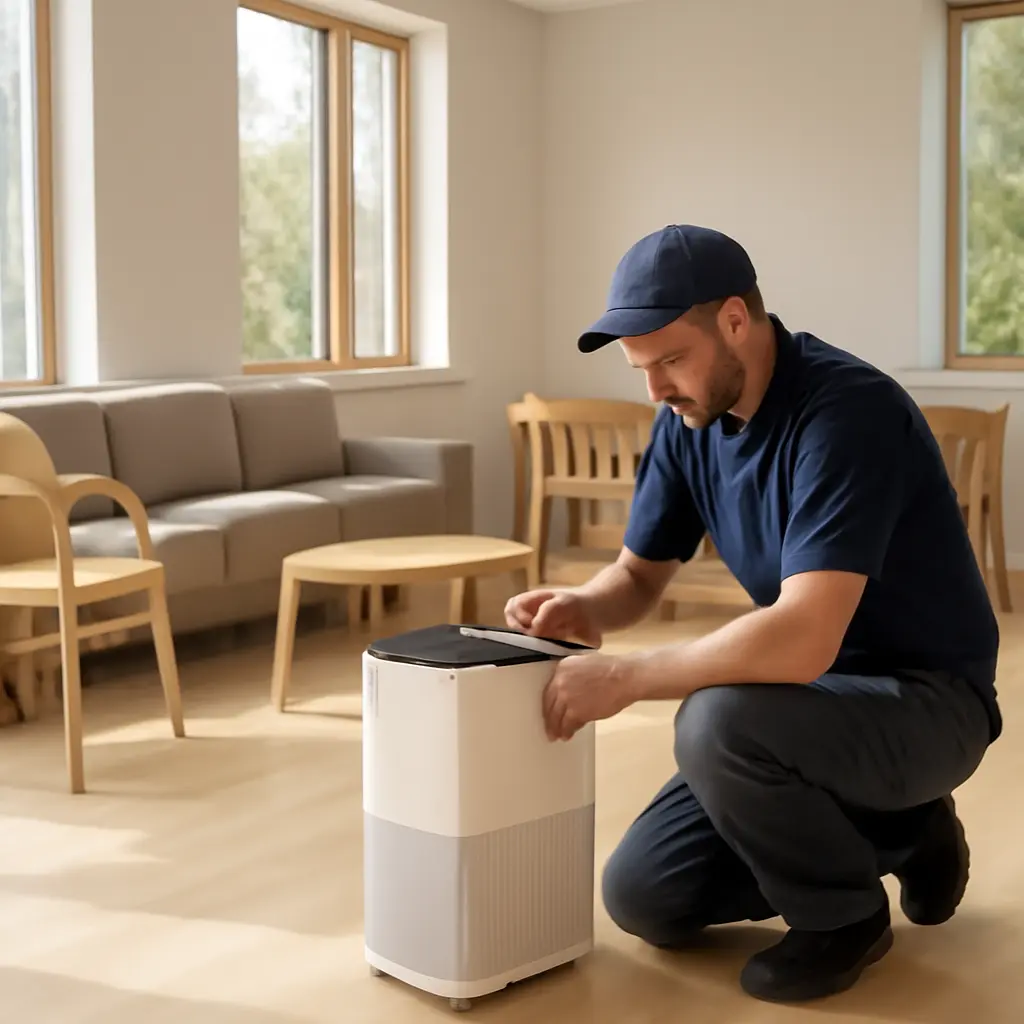
Choose and place a portable air cleaner
A portable cleaner with a high-efficiency particle filter can capture airborne particles such as smoke and dust. Select a unit with a CADR appropriate to the room’s size, place it where air can circulate freely, and run it at a setting occupants can tolerate. For gases and odors, look for a substantial activated-carbon or other pollutant-specific media layer, while recognizing that these materials have limited capacity and need replacement. Avoid devices that intentionally produce ozone; the EPA identifies ozone as a lung irritant.
Use monitoring as a guide, not a diagnosis
A carbon monoxide alarm is an essential life-safety device for detecting dangerous CO. Consumer particle monitors can help reveal patterns—for example, a rise in particles during frying or when smoke enters from another room—but readings vary by device and do not identify every pollutant. Odor alone is also an unreliable measure of safety: some harmful gases have little or no smell, while noticeable odors may occur at levels that do not indicate a specific health risk.
A practical room-to-room checklist
- Identify the likely source and stop or reduce it first.
- Keep doors between the source and cleaner rooms closed when practical, while preserving required ventilation and safety openings.
- Use an outdoor-vented exhaust near cooking or other emissions, and avoid directing airflow toward occupied rooms.
- Maintain HVAC filters and use a correctly sized portable particle cleaner as a supplement.
- Install and test carbon monoxide alarms; leave and seek emergency help if an alarm activates.
- If drift persists, document when it occurs and ask building management or a qualified professional to inspect shared ducts, pressure, and leakage.
Conclusion: prevent pollutants at the source and contain the airflow
Pollutants drift between connected living spaces through air mixing, pressure differences, ducts, and building leaks. Source control—especially keeping smoke out, capturing cooking emissions, and maintaining combustion appliances—is the strongest starting point. Local exhaust, sensible room separation, balanced HVAC operation, and appropriately selected filtration add protection when used together. Because indoor air quality depends on the pollutant and the building, take immediate safety concerns seriously, maintain alarms and ventilation equipment, and consult building or HVAC professionals when contaminants repeatedly cross rooms or apartments.
Sources: U.S. Environmental Protection Agency, Indoor Air Quality, https://www.epa.gov/indoor-air-quality-iaq; U.S. Environmental Protection Agency, Guide to Air Cleaners in the Home, https://www.epa.gov/indoor-air-quality-iaq/guide-air-cleaners-home; World Health Organization, WHO Global Air Quality Guidelines, 2021, https://www.who.int/publications/i/item/9789240034228; Centers for Disease Control and Prevention, About Secondhand Smoke, https://www.cdc.gov/tobacco/secondhand-smoke/about.html; California Air Resources Board, Indoor Air Quality and Cooking, https://ww2.arb.ca.gov/resources/documents/indoor-air-quality-cooking; Centers for Disease Control and Prevention, Ventilation in Buildings, https://www.cdc.gov/niosh/ventilation/about/index.html.
Related Posts
Nanotech air purifiers work differently, and here’s why that matters
Nanotechnology-based air purifiers use engineered materials or nanoscale structures to…

The Surprising History Behind HEPA Becoming an Industry Standard
High-Efficiency Particulate Air (HEPA) filtration is a performance-based air-cleaning technology…

Smart Air Purifier Strategies for Multi Generational Homes
Smart Air Purifier Strategies: Adaptive Indoor-Air Protection for Multigenerational Homes…