
Connected air-quality monitoring and purification systems combine sensors, software, and air cleaners to track indoor conditions and respond to pollutants. Their rise reflects a practical public-health need: the World Health Organization estimates that household and outdoor air pollution together are associated with about 6.7 million premature deaths annually, while the U.S. Environmental Protection Agency notes that people spend roughly 90% of their time indoors. By linking measurements to filtration and ventilation controls, these systems can help building managers and households identify pollution events, assess interventions, and maintain cleaner air—provided they are selected, calibrated, and operated with care.
Connected air-quality systems define monitoring and response
An indoor air-quality monitoring and purification system is a set of devices and services that measures selected pollutants or environmental conditions, communicates readings, and uses those readings to guide or automate actions such as filtration or ventilation. The U.S. Environmental Protection Agency describes indoor air quality as the characteristics of indoor air that affect occupants’ health, comfort, and ability to work. Connected systems extend conventional monitoring by linking sensors to networks, dashboards, alerts, and, in some installations, automatic controls.
The category includes standalone smart purifiers, multi-sensor monitors, building-management integrations, and distributed networks of room sensors. These products do not all measure the same pollutants or provide equivalent accuracy. A reading is evidence about a particular sensor and location, not a complete diagnosis of a building’s air or a guarantee of health protection.
Monitoring: sensors, measurements, and interpretation
Monitoring means collecting and interpreting measurements over time. Common consumer devices measure particulate matter such as PM2.5, carbon dioxide, temperature, and relative humidity; some also estimate volatile organic compounds or detect carbon monoxide. These variables are not interchangeable. PM2.5 refers to particles no larger than 2.5 micrometers, while carbon dioxide is often used as an indicator of ventilation and occupant-generated air—not as a comprehensive measure of indoor pollution.
Sensor technology determines what a monitor can reliably report. Optical particle sensors estimate particle concentrations by detecting scattered light; low-cost versions can be affected by humidity, particle composition, placement, and maintenance. The U.S. EPA advises consumers to understand a monitor’s intended use and limitations, and to avoid treating a single reading as a complete assessment. For decisions with health, compliance, or building-performance consequences, calibrated instruments and qualified professional interpretation may be necessary.
Purification: filtration and pollutant removal
Purification is the removal or reduction of contaminants using filtration or other treatment technologies. High-efficiency particulate air (HEPA) filters capture particles, including many particles in the size range of concern for health. Activated carbon can reduce some gases and odors, but its effectiveness depends on the type and quantity of carbon and on the pollutant. Portable air cleaners are commonly rated by clean air delivery rate (CADR), which helps consumers compare particle-cleaning performance for an appropriate room size.
Filtration does not remove every indoor hazard. A particle filter will not reliably address carbon monoxide, radon, or all gaseous chemicals. The EPA’s core approach to indoor air quality prioritizes source control, improved ventilation where appropriate, and air cleaning as a supplement. Eliminating a pollutant source—for example, stopping indoor smoking or controlling moisture—may be more effective than relying on a purifier alone.
Connectivity: data, alerts, and automated control
Connectivity links sensor readings to applications, cloud platforms, or building systems through technologies such as Wi-Fi, Bluetooth, or building-automation protocols. Users may see trends, receive alerts, or schedule an air cleaner. In more advanced systems, a controller can increase filtration when particle levels rise or adjust ventilation in response to occupancy or carbon dioxide readings.
Automation can make response faster, but it depends on sound thresholds and reliable equipment. A connected device may lose network access, produce false alarms, or act on a sensor that is poorly placed. Systems should provide understandable measurements, clear maintenance notices, and manual controls. Networked devices also collect data, so buyers should review privacy policies, retention practices, and security-update commitments.
Connected air-quality systems improve awareness and response
The principal benefit of connected monitoring is visibility: occupants and operators can observe changes that might otherwise go unnoticed. The value is greatest when data informs a practical response, such as identifying a cooking-related particle spike, replacing a loaded filter, or investigating persistently elevated carbon dioxide. A monitor alone does not clean air, and an air cleaner without useful placement and maintenance may deliver less protection than expected.
Early warning and source investigation
Time-series data can reveal patterns linked to daily activities, equipment, or outdoor pollution. For example, a particle monitor may show repeated spikes during cooking, prompting use of a range hood that exhausts outdoors and a properly sized particle cleaner. A sudden increase can also prompt checks for smoke intrusion, construction dust, or a malfunctioning appliance. These observations support investigation; they do not identify a pollutant’s source with certainty.
The distinction matters because different contaminants require different actions. If a carbon monoxide alarm sounds, occupants should follow emergency guidance rather than relying on a general-purpose air-quality monitor. If moisture or mold is suspected, correcting the water problem is essential; ordinary particle filtration does not resolve the underlying source.
Demand-controlled filtration and ventilation
Demand-controlled systems adjust equipment in response to measured conditions or occupancy. A purifier may increase fan speed during a particle event, while a building system may use carbon dioxide as one input for ventilation control. Such strategies can make operation more responsive, but carbon dioxide should be interpreted carefully: occupancy, outdoor-air supply, room size, and sensor location all affect its reading.
A 2021 study published in Building and Environment examined portable air cleaners in classrooms and found that appropriately sized units can increase equivalent clean-air delivery. The finding supports filtration as one layer of risk reduction, not as a substitute for ventilation, source control, or other public-health measures. Performance in a particular room depends on airflow, placement, operating speed, noise tolerance, and filter condition.
Building operations and public-health planning
In schools, offices, healthcare settings, and multifamily housing, connected readings can help facilities teams compare rooms, prioritize inspections, and document equipment operation. A network of sensors may reveal that one area has weaker ventilation or recurring pollution events. For credible comparisons, sensors need consistent placement, documented calibration, and a defined response plan; otherwise, apparent differences may reflect device variation rather than real building conditions.
The COVID-19 pandemic increased attention to ventilation and filtration. In 2023, the U.S. Centers for Disease Control and Prevention recommended aiming for at least five air changes per hour of clean air in occupied indoor spaces when feasible, using ventilation, filtration, or other appropriate measures. This is a clean-air target, not a guarantee of safety, and the best combination varies by building and activity.
Connected air-quality systems face accuracy, privacy, and equity challenges
Connected systems can produce more data than users can meaningfully interpret. Their impact depends on measurement quality, suitable equipment, maintenance, and the ability to act on findings. Cost and access also matter: a household may identify a problem but lack control over building repairs or the resources to purchase and operate effective filtration.
Sensor accuracy and placement
Low-cost sensors are useful for observing trends, but performance can vary by model and pollutant. EPA guidance on air sensors emphasizes that non-regulatory sensors are not equivalent to reference-grade instruments and may not be appropriate for every decision. Devices placed beside a window, near a purifier’s outlet, or directly above a cooking surface may give readings that do not represent the room as a whole.
Users should consult manufacturer instructions, keep inlets unobstructed, and avoid comparing readings from different models as though they were interchangeable. For a suspected serious hazard, use the relevant certified detector or contact a qualified professional rather than relying on a general consumer monitor.
Maintenance, noise, and operating cost
A purifier’s performance depends on regular use and maintenance. Filters require replacement according to their condition and the manufacturer’s instructions; a clogged filter can restrict airflow, while an incorrectly installed filter may allow air to bypass it. High fan settings can improve clean-air delivery but may increase noise and energy use, leading occupants to switch the device off.
Before purchase, compare CADR with room area, check replacement-filter availability and cost, and consider whether the device can run at a tolerable speed. Avoid ozone-generating air cleaners: the EPA warns that ozone is a lung irritant and that concentrations high enough to remove indoor pollutants can be harmful.
Privacy, cybersecurity, and unequal access
Connected monitors may record occupancy patterns, room conditions, and device-use data. Organizations should determine what information is collected, where it is stored, who can access it, and how long it is retained. Strong passwords, supported software, limited permissions, and secure network practices reduce avoidable cybersecurity risks.
Benefits may be unevenly distributed. Renters and lower-income households may have little authority over ventilation or building repairs, even when monitoring identifies a concern. Public programs, building codes, school investment, and landlord-tenant processes can help turn information into corrective action rather than shifting responsibility to individuals who cannot control the source.
Connected air-quality systems work best through evidence-based deployment
A useful deployment starts with the problem, not the device. Identify whether the priority is particles, gases, ventilation, or a broader building assessment; choose a monitor designed for that purpose; and pair its readings with an appropriate response. For particle reduction, select a cleaner with a suitable CADR and place it where air can circulate. For ventilation concerns, assess the building system rather than interpreting a single carbon dioxide value in isolation.
- Identify likely pollution sources and address them where possible.
- Choose sensors that measure the pollutants relevant to the space, and review their limitations.
- Size filtration to the room and use the highest practical operating setting.
- Combine air cleaning with appropriate ventilation and routine equipment maintenance.
- Set clear thresholds and response procedures before enabling automatic actions.
- Review privacy, cybersecurity, ongoing costs, and access to replacement parts.
For readers comparing options, the EPA’s indoor-air guidance, its consumer information on air cleaners and filters, and CDC ventilation recommendations offer useful starting points. In schools and workplaces, facilities professionals can complement those resources with engineering assessments and documented commissioning.
Conclusion: connected air-quality systems turn measurements into action
Connected air-quality monitoring and purification bring together sensors, filtration, software, and building controls. Monitoring can reveal patterns; purification can reduce selected contaminants; connectivity can deliver alerts and automate response. Their effectiveness, however, rests on sensor limits, correct sizing, maintenance, ventilation, source control, and responsible data handling. As awareness of indoor air grows, the most useful next step is to identify the pollutants relevant to a space, consult authoritative guidance, and choose a measurable response that occupants and building operators can sustain.
Sources: World Health Organization, “Household air pollution and health,” https://www.who.int/news-room/fact-sheets/detail/household-air-pollution-and-health; U.S. Environmental Protection Agency, “Indoor Air Quality,” https://www.epa.gov/report-environment/indoor-air-quality; U.S. Environmental Protection Agency, “Air Cleaners and Air Filters in the Home,” https://www.epa.gov/indoor-air-quality-iaq/air-cleaners-and-air-filters-home; U.S. Environmental Protection Agency, “Air Sensor Guidebook,” https://www.epa.gov/air-sensor-toolbox/how-use-air-sensors-air-sensor-guidebook; U.S. Centers for Disease Control and Prevention, “Ventilation in Buildings,” https://www.cdc.gov/niosh/ventilation/about/index.html; U.S. Environmental Protection Agency, “Ozone Generators that are Sold as Air Cleaners,” https://www.epa.gov/indoor-air-quality-iaq/ozone-generators-are-sold-air-cleaners; “Portable air cleaners and classroom air quality: A review of the literature,” Building and Environment, 2021, https://doi.org/10.1016/j.buildenv.2021.108344.
Related Posts
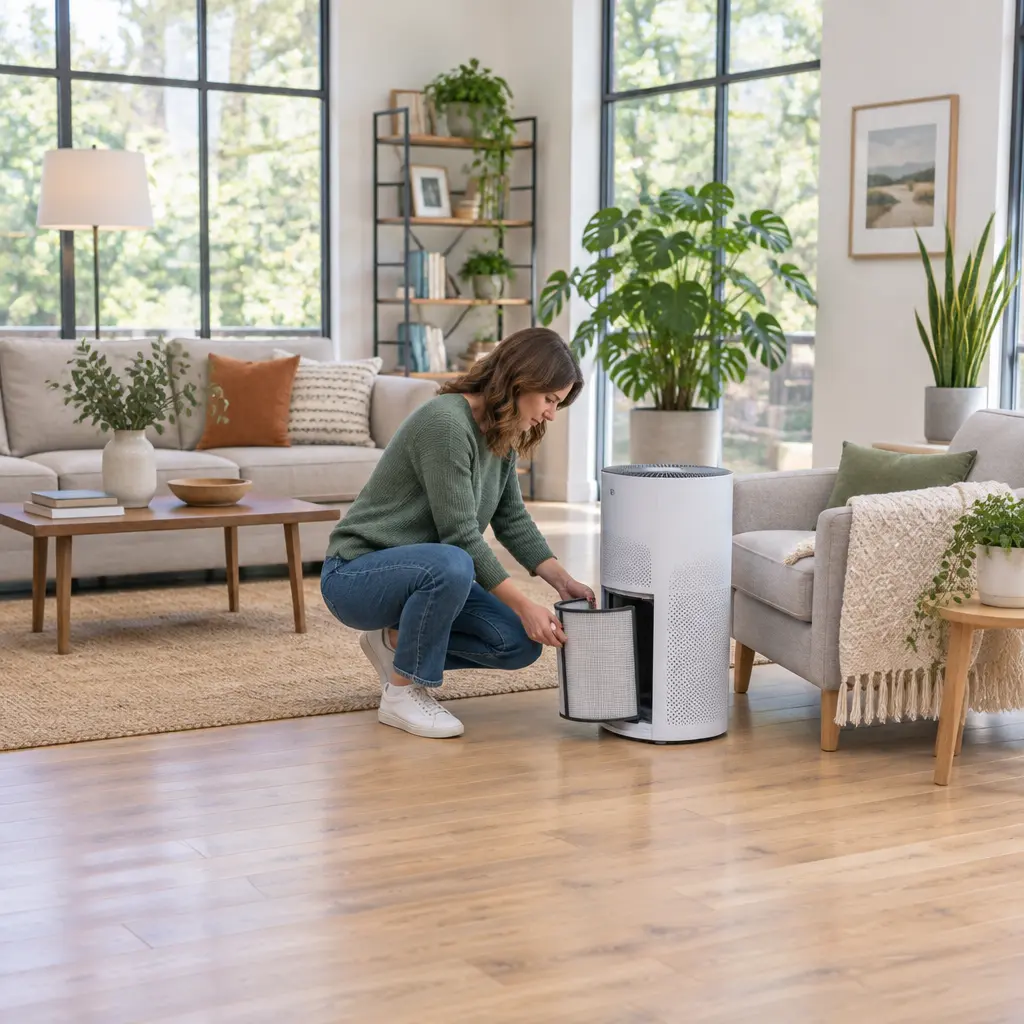
What to Actually Look for When Comparing Air Purifier Brands and Models
Air purifiers are appliances that reduce certain airborne particles or…

How Electrostatic Filters Compare to HEPA in Real Homes
Electrostatic Filters: Real-Home Performance Compared with HEPA Air Cleaning Electrostatic…
What Air Purifiers Actually Remove and What They Can’t
Air purifiers are devices that draw air through filters or…