
An air purifier filter captures particles as air passes through the purifier; knowing when to replace it helps preserve airflow and filtration performance. The right interval depends on the filter type, purifier model, hours of use, and indoor conditions—not a single universal timetable. Manufacturer guidance is the best starting point: many HEPA filters are designed to last roughly 6–12 months, while activated-carbon filters may need replacement sooner, often around 3–6 months. Check the unit’s indicator and manual, and pay attention to heavy use, smoke, pets, dust, odors, and reduced airflow. The sections below explain filter types, practical warning signs, replacement schedules, and safe upkeep.
Replacement timing for air purifier filters
There is no industry-wide replacement deadline for every air purifier. The U.S. Environmental Protection Agency (EPA) advises following the manufacturer’s instructions for maintaining portable air cleaners, including replacing filters as directed. A filter’s service life is affected by how much air it processes and how much material it collects; a purifier running continuously in a dusty or smoky room will generally load its filter faster than one used occasionally in a clean room.
Filter life is also tied to performance. The Association of Home Appliance Manufacturers (AHAM) uses the Clean Air Delivery Rate (CADR) to describe how quickly a portable air cleaner delivers filtered air, with ratings reported for smoke, dust, and pollen. CADR is not a filter replacement clock, but it helps explain why maintaining the appliance matters: a loaded filter or obstructed airflow can undermine the purifier’s ability to circulate air as intended.
HEPA and high-efficiency particle filters
A HEPA filter is a mechanical filter designed to capture airborne particles. In the United States, the Department of Energy definition commonly cited for HEPA filters requires at least 99.97% efficiency at capturing particles of 0.3 microns under specified test conditions. That rating describes filtration performance when the filter is properly fitted and used; it does not mean the filter lasts indefinitely or that every product marketed as “HEPA-type” meets the same standard.
Many household purifier manuals suggest replacing a HEPA filter about every 6–12 months, but the exact schedule varies. Follow the model’s instructions and replace it earlier if the purifier’s indicator calls for it, airflow has noticeably weakened, or the filter is visibly damaged. Do not wash a HEPA filter unless its manufacturer explicitly says it is washable: moisture and handling can damage some filter media.
Activated-carbon filters for odors and gases
Activated carbon is a porous material used to adsorb certain gases and odors. Unlike a particle filter, a carbon filter’s performance is not judged by how much visible dust it holds. Its capacity depends on the amount and type of carbon, the chemicals present, humidity, and how long air contacts the media. EPA guidance notes that air cleaners designed to remove gases use sorbent materials such as activated carbon; performance varies by product and contaminant.
Carbon filters may need replacement before a HEPA filter, especially in homes with persistent cooking smells, smoke, or other strong odors. A return of odors can be a practical warning, but it is not a precise measurement of remaining capacity. Use the purifier’s manual as the schedule and do not assume that a particle-filter indicator can detect exhausted carbon media.
Pre-filters and washable components
A pre-filter is an upstream screen or mesh that catches larger particles, such as lint and hair, before they reach the main filter. Some models have washable or vacuum-cleanable pre-filters, while others use disposable ones. Cleaning a reusable pre-filter at the interval specified by the manufacturer can help maintain airflow and may reduce the load on the primary filter, but it does not reset the service life of a HEPA or carbon filter.
For example, a home with shedding pets may need more frequent pre-filter cleaning than a home without pets. Let washable components dry completely before reinstalling them, and never wash a filter that the manual identifies as disposable.
Warning signs that an air purifier filter needs attention
Calendar estimates are useful, but they should be considered alongside the purifier’s condition and the manufacturer’s indicator. A warning light may be based on elapsed run time rather than a direct measurement of how clogged or effective a filter is. Treat it as a prompt to inspect the manual and filter, not as a universal laboratory test of filter performance.
Reduced airflow or a persistent change in sound
If the unit’s airflow seems weaker than usual, first check that air inlets and outlets are not blocked by furniture, curtains, or dust. Then inspect and clean the pre-filter if the model permits. A heavily loaded filter can restrict airflow, but fan settings, obstructions, and mechanical issues can also cause the same symptom. If airflow remains low after basic checks, consult the manual and replace the filter if indicated.
Visible loading, damage, or returning odors
A visibly dusty pre-filter can often be cleaned according to the instructions. A main filter that is torn, misshapen, wet, or poorly seated should be addressed promptly because air may bypass the filter media. For carbon filters, odors returning during normal operation may signal that the sorbent has reached its useful capacity. Appearance alone, however, cannot confirm that a filter is still effective or exhausted.
Longer or heavier-than-usual operation
Usage conditions help interpret the schedule. Running a purifier around the clock, frequent cooking, indoor smoking, renovation dust, wildfire smoke, and high levels of pet hair or dust can increase the burden on filters. During smoke events, the EPA recommends using an appropriately sized portable air cleaner and keeping indoor air as clean as possible; afterward, inspect the filter and follow the manufacturer’s replacement instructions rather than assuming it must be replaced solely because an event occurred.
How to set a practical replacement schedule
A workable schedule combines the model’s recommended interval with operating conditions and regular checks. The following ranges are common examples, not guarantees; a specific purifier’s manual takes precedence.
- Washable or reusable pre-filter: clean as often as the manual advises, and more often when it visibly collects hair or lint.
- Activated-carbon filter: often replaced every few months, commonly around 3–6 months, depending on the model and odor or gas load.
- HEPA or other high-efficiency particle filter: often replaced around every 6–12 months, subject to the manufacturer’s guidance and use.
These ranges vary significantly across brands and designs. Some purifiers use combined filter cartridges, while others have separate particle and carbon stages. Check whether the replacement indicator tracks run time, whether filters can be reset after installation, and which exact replacement part fits the model.
A simple inspection routine
- Write down the installation date and the filter model number.
- Check the manual for the recommended interval, cleaning method, and indicator-reset steps.
- Inspect the pre-filter and airflow periodically, especially after heavy use or an indoor smoke or dust event.
- Replace filters when the manual or indicator calls for it, or when there is damage or persistent loss of performance after checking for obstructions.
- After replacement, confirm the filter is seated correctly and reset the indicator only as instructed.
A small maintenance log can make replacement decisions more consistent. For instance, a household that records a new filter in early spring can compare the next year’s airflow, odor, and indicator behavior with its actual usage rather than relying on memory.
Safe replacement and filter disposal
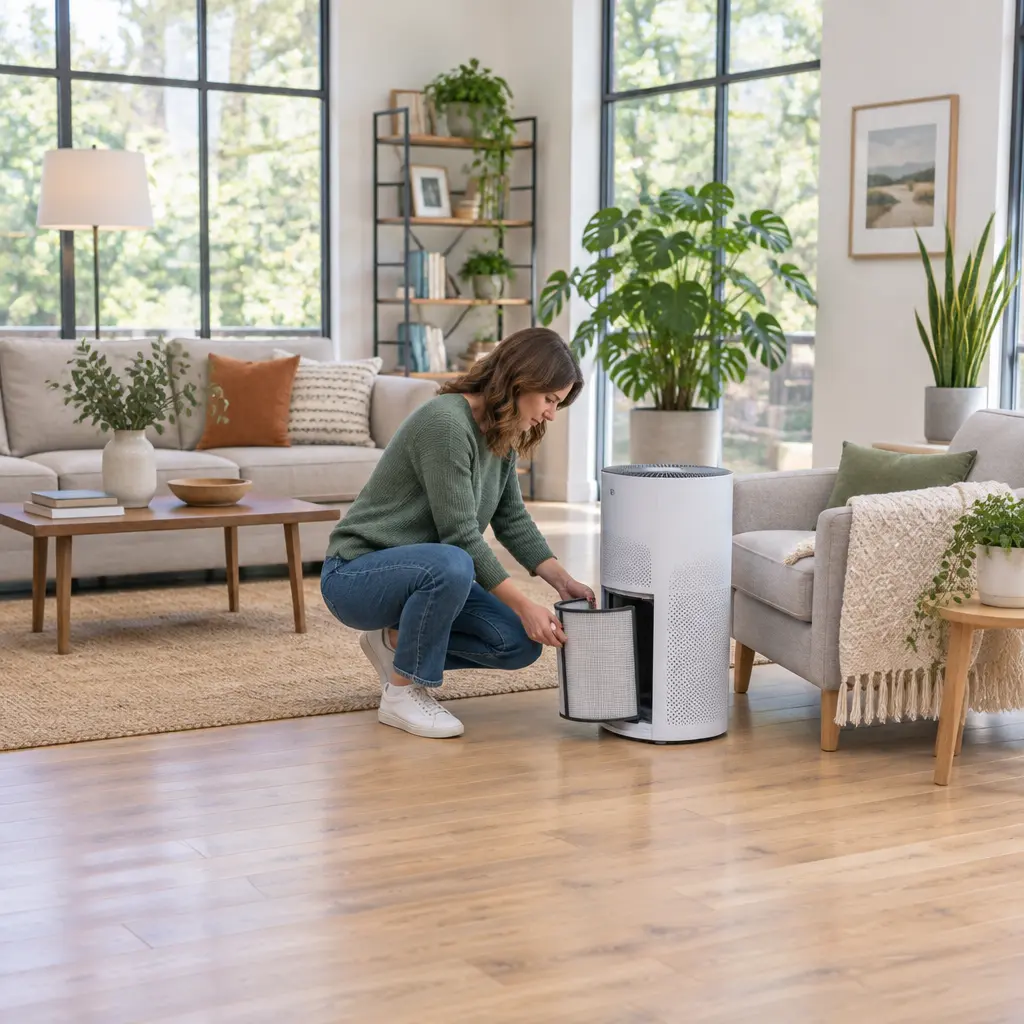
Turn off and unplug the purifier before opening it, then follow the manufacturer’s instructions for removing the filter. Avoid shaking a dusty filter indoors. If dust, smoke residue, or other material is a concern, handle the filter gently and place it in a bag for disposal; use local waste guidance because recycling and disposal options differ by filter construction and location. Clean only the parts that the manual identifies as cleanable, and keep water away from non-washable filter media.
Replacing a filter does not replace other steps for improving indoor air. The EPA recommends addressing pollution sources and using ventilation when appropriate, alongside filtration. A correctly sized, well-maintained purifier can be one part of an indoor-air strategy, but it cannot eliminate every pollutant or substitute for source control.
Conclusion: Replace filters by condition and manufacturer guidance
The best time to replace an air purifier filter depends on its type, the appliance’s instructions, and how heavily it is used. HEPA filters commonly have longer service intervals than activated-carbon filters, while pre-filters may need regular cleaning. Reduced airflow, visible damage, returning odors, and replacement indicators are useful prompts—but none should override the model-specific manual.
Check your purifier’s model and filter instructions, note the installation date, and inspect it regularly, especially after periods of smoke, dust, or intensive use. For further guidance, consult the EPA’s materials on residential air cleaners and your manufacturer’s maintenance documentation.
Sources: U.S. Environmental Protection Agency, Guide to Air Cleaners in the Home, https://www.epa.gov/indoor-air-quality-iaq/air-cleaners-and-air-filters-home; U.S. Environmental Protection Agency, Wildfires and Indoor Air Quality, https://www.epa.gov/indoor-air-quality-iaq/wildfires-and-indoor-air-quality-iaq; Association of Home Appliance Manufacturers, Air Cleaner Certification Program and CADR, https://ahamverifide.org/ahams-air-filtration-standards/; U.S. Department of Energy, HEPA Filters, https://www.energy.gov/ehss/hepa-filters.
Related Posts

Why Quiet Air Purifiers Make Life Easier With Kids at Home
Quiet air purifiers are portable filtration devices designed to reduce…
What to Actually Look for When Comparing Air Purifier Brands and Models
Air purifiers are appliances that reduce certain airborne particles or…

How Air Purifiers Actually Clean Your Indoor Air
Air Purifiers: Filtration Technologies and How They Clean Indoor Air…